 Emir Bardakçı
With the rapid adoption of true wireless earbuds across the continent, compact audio devices have become an integral part of everyday life in Europe, but this has also increased the chances of losing them. Xiaomi’s Redmi Buds, Xiaomi Buds, and their POCO-branded equivalents—sold as the Xiaomi T series globally—are among the most popular in the European Economic Area, where their small size and wireless design can be a practical disadvantage.
Understanding what can and cannot be done in case of loss will help manage expectations and take appropriate technical measures.
How to locate Xiaomi headphones
Before attempting recovery, it’s crucial to understand the technical limitations of wireless earbuds. Unlike smartphones, Xiaomi earbuds don’t include GPS modules or cellular connectivity. Therefore, location detection must be indirect and relies entirely on Bluetooth signals and software ecosystems.
Modern Xiaomi earbuds use Bluetooth Low Energy, typically based on Bluetooth 5.2 or 5.3, or newer standards. When an earbud is removed from its charging case and has some battery power, it periodically emits a signal. Smartphones can estimate proximity using signal strength values, commonly referred to as RSSI. This method only works for short distances, usually less than ten meters, and thick walls, common in European buildings, will weaken the signals considerably.
Normally, when the earbuds are inside the charging case and the lid is closed, Bluetooth transmission is disabled at the hardware level. In this state, digital tracking is not possible. Of course, once the battery is completely depleted, all signal transmission ceases, making recovery a purely physical search.
Effective use of Xiaomi and Google software tools
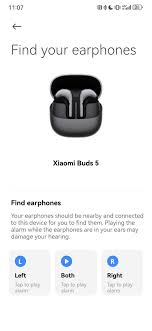
Xiaomi, for its part, offers simple recovery functions through its official headphone management app. The «Find Your Headphones» feature is only useful in quiet indoor environments, such as homes or offices, as it allows users to play loud music from the headphones, provided they are connected to the phone.
The app also records the last known location where the Bluetooth connection was active. This is static information and is not updated if the headphones are moved at any point afterward. It should be used more as a reference point than as live tracking data.
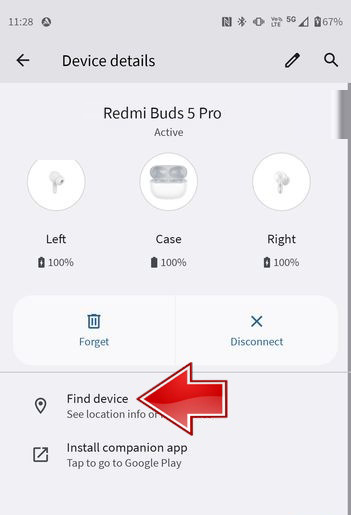
Xiaomi’s new Google Fast Pair-compatible earbuds can integrate with Google’s «Find My Device» network. If an Android device is near an earbud that’s been misplaced, it can anonymously detect the Bluetooth signal and report an approximate location to the owner. This can be very useful if you lose your earbuds in a busy urban area, although the earbuds must have some battery power. A completely dead earbud cannot be located through this network.
Practical steps for recovery in Europe
Timing is crucial when headphones are lost. When the device still has power, acting quickly improves the chances of recovering them.
Check the last known location of your Xiaomi Earbuds in the app or using Google Find My Device. Return to that area with Bluetooth enabled. Indoors, reducing background noise and enabling audible alerts will help narrow down their location. Third-party Bluetooth scanner apps can assist advanced users by showing how signal strength changes as a person moves around a space.
If the item was lost on public transport or in a shared space, contact your local lost and found services. European transport operators often list small electronic items only by description, without serial numbers, but having proof of purchase can be helpful.
Replacement options and cost considerations
If repair is unsuccessful, replacement becomes the next option. With very few exceptions, official individual earbuds or charging cases are rarely sold as stock items through official Xiaomi channels in Europe. Authorized service centers may offer some replacements for a fee, with prices often approaching those of a new set, especially for budget models.
Individual problems with third-party vendors
Some third-party sellers offer individual earbuds, mostly sourced from outside the EU. While this saves money on higher-end models, shipping times and potential warranty limitations should be carefully considered. For more affordable Redmi Buds, buying a new pair is often the most convenient and practical option.
After replacing a single earbud, users must perform a full reset and re-pair the device so that the new and existing earbuds can properly synchronize. Firmware updates via the official app are highly recommended for stable performance.
Future preventative measures
Sometimes, prevention is better than cure. Enabling Google Find My Device in your settings is highly recommended. Protective cases with connected key fobs or an external Bluetooth tracker inside the charging case can greatly reduce most risks. Regularly updating your system apps through trusted sources like HyperOSUpdates.com or using tools like the MemeOS Enhancer app will give you access to the latest features added to the ecosystem and all the stability improvements.
Losing a pair of European Xiaomi earbuds is a manageable situation once you understand the technical and logistical aspects. Bluetooth-based recovery tools may work under certain conditions, and no guarantees are offered. For premium models, replacing a single module can be cost-effective; for entry-level models, a complete replacement is usually more advisable. As is often the case, the best strategy remains proactive prevention, which combines software activation with physical accessories and informed usage habits.